
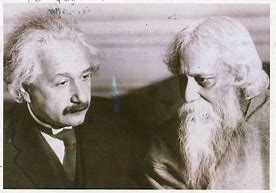
“I am not a scientist, but from childhood my strong desire to enjoy the rasa of science knew no bounds.” – Rabindranath Tagore
The Renaissance occurred in India in every aspect of society, in the 2nd half of the 19th century, flowing into the twentieth is vital in order to understand Tagore. Then a creative synthesis of the best of the East & the West took place in science, literature and culture. His poetry has an impressive wholeness, he moves with effortless ease from the literal to the symbolic, from the part to the whole, from a tiny detail to the vast cosmos. His sense of science reflected in his writings.
In 1885, ‘BALAKA’, a journal was started in the Tagore family, Rabindranath took an active part in its editing and publication and also wrote ‘Vignan Sanbad’. Tagore’s interest in science can be traced from his early teens. He loved astronomy, eminent astrophysicist Meghnad Saha persuaded him to write ‘Visvaparichaya’, which he dedicated to Satyaendranath Bose.
Werner Karl Heisenberg, Nobel Laureate in Physics had several conversations with Tagore about core physics and impermanence as fundamental aspects of physical reality. Later he said: “Some of the ideas that had seemed so crazy, suddenly made much sense. That was a great help for me.” “The Religion of Man” at Europe’s College brought him closer to Einstein. Nobel laureate scientist in chemistry Ilya Prigogine remarked in 1984 that “Curiously enough, the present evolution of science is running in the direction stated by the great Indian poet.”
In India, Pathbhabana is the 1st institution where learning of science by direct practical experiment was introduced at primary level. Syed Mustaba Ali wrote in one of his articles; allusions and references of things scientific and medical fascinated both Shakespeare and Rabindranath. Tagore’s interest in contemporary sciences, astronomy, astrophysics, biology, and his inquisitiveness for scientific knowledge and information made him a prolific reader and thinker, reflected scattered & limitlessly in his literary works.
The myth of Geocentric universe (earth is the centre of the universe) was shattered by Copernicus. Tagore expressed the whole concept of Copernicus’s Heliocentric universe (the sun is the centre of the universe) in a beautiful way in his poem ‘Basundhara’ in his book of poems ‘Sonar Tori’.
In his poem ‘Sabitri’ he gave an account of how different elements are constantly burning and generating heat. In that gaseous melee, the poet imagined the presence of ‘Saraswati’, the goddess of learning. He felt the influence of solar power within himself and introduced that to the readers.
In ‘Pancha Diary’, he mentions if heat is the source of motion, then matter exists & moves only when there is heat. If heat is exhausted, then everything comes to a standstill. The idea touches the 2nd law of thermodynamics. It has been held that the Universe constitutes a thermodynamically closed system, and if this were true, it would mean that a time must come when the Universe unwinds itself, no energy being available. This state is referred to as the “Heat death of the Universe”. In his statement Rabindranath considers this aspect and expressed apprehension.
In ‘Sesher Kabita’ the hero Amit Ray, mentions time-space relation and time dilation as thought by Einstein and the very basic concept of the relationship of man, universe and velocity found literary expression. Einstein’s Theory of Relativity got a new easier & popular dimension in the novelist’s classic.
The evidence of Tagore’s inquisitiveness about the Universe is scattered in his writings over 40 years. The Universe always roamed in the corridor of his mind. Rabindranath seemed to be ambivalent with a bit of concern about the apparent incompatibility, conflict and contradiction between objectivity in science, literary and artistic imagination or innovation. Rabindranath felt that Western literature of the modern period had fallen victim to just such an aggression from reductionist modern science.
The Poet was immensely influenced by the Theory of Evolution by Darwin. In one letter in ‘Chinnapatra’, he said: “I can clearly remember that many thousand years ago I was born as a tree on this planet earth and on that day in the morning rays from the new sun were flashing on my body.”
“Wisest is he who knows what he does not know”, said Plato. Following that we can say, Tagore too knew his limitations and that is well expressed in the Introduction of his only book on popular science ‘Visvaparichaya’. He was a wise man with multi-faceted talents. Einstein once said, “Experimentation with instruments only does not make one a scientist, to me scientific mind makes one a real scientist”. And Tagore fits to this definition of scientist perfectly.

 Albi's blog